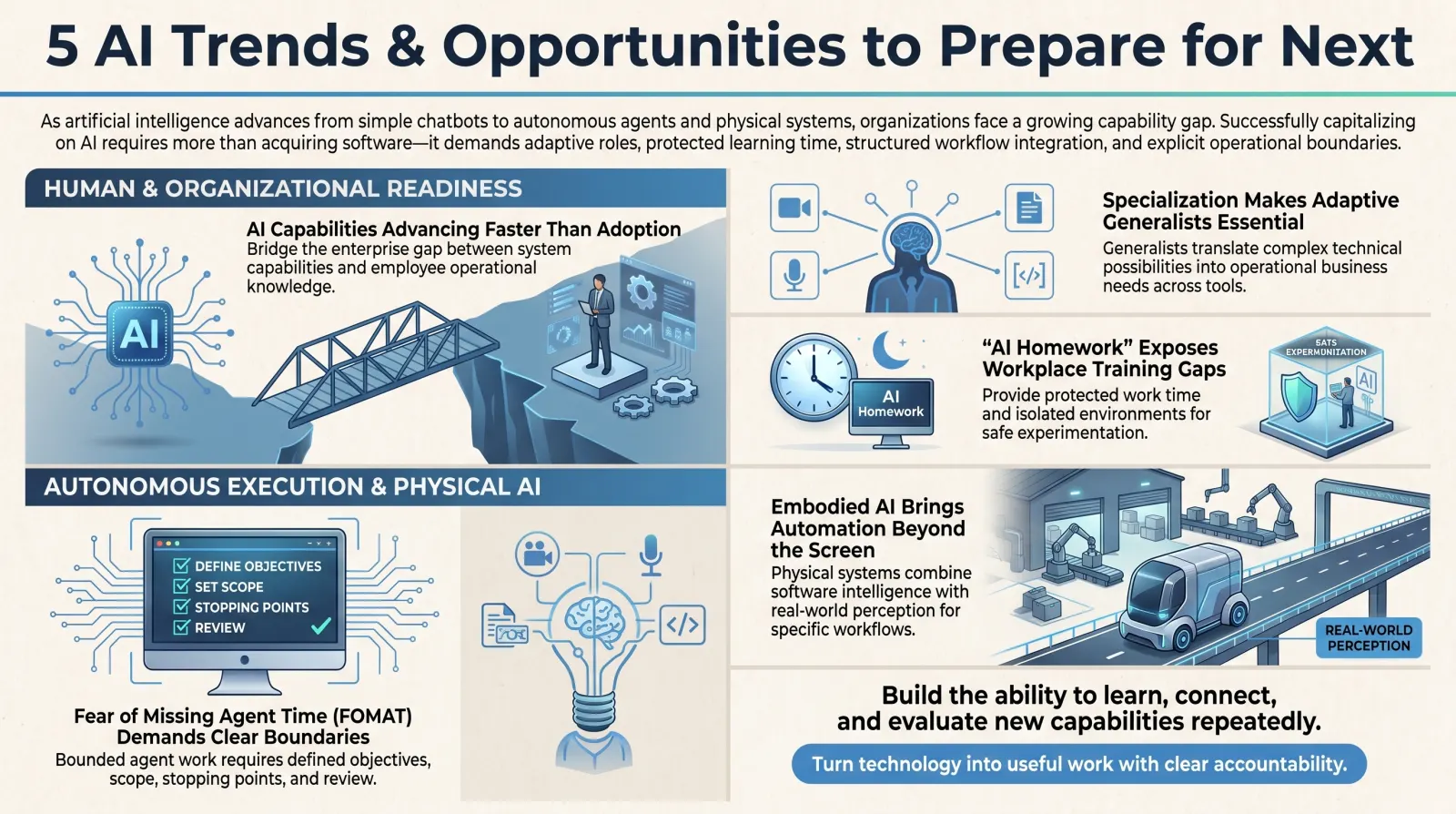
The next phase of artificial intelligence is about more than better chatbots. AI agents can perform tasks across tools, specialists are working in increasingly narrow fields, and autonomous systems are bringing AI into the physical world. Meanwhile, businesses are struggling to turn expanding capabilities into practical results.
The biggest opportunity is closing the distance between what AI can do and what people can use effectively. That requires more than buying software. It requires training, integration skills, protected experimentation time, and clear boundaries for systems that take action.
Five developments deserve particular attention: the widening AI capability gap, the growing importance of adaptive generalists, after-hours AI learning, pressure to keep agents working continuously, and the expansion of embodied AI.
These are directional trends, not guaranteed forecasts or a complete map of the industry. For business leaders and knowledge workers, their value lies in identifying where to experiment, which skills to develop, and what problems to address before they become larger obstacles.
Key Takeaways
- The gap between AI capabilities and workplace use creates opportunities for practical training and workflow improvement.
- Adaptive generalists help specialists and business teams connect increasingly fragmented AI tools.
- Protected experimentation time reduces reliance on after-hours learning and supports shared organizational knowledge.
- Agents and embodied AI require bounded trials, clear oversight, and evaluation beyond impressive demonstrations.
Table of Contents
- 1. AI Capabilities Are Advancing Faster Than Workplace Adoption
- 2. AI Specialization Is Making Adaptive Generalists More Valuable
- 3. “AI Homework” Is Exposing a Workplace Training Problem
- 4. AI Agents Are Creating Fear of Missing Agent Time
- 5. Embodied AI Is Bringing Automation Beyond the Screen
- How to Capitalize Without Chasing Every AI Release
1. AI Capabilities Are Advancing Faster Than Workplace Adoption
The central enterprise AI challenge is increasingly a capability gap: the difference between what available systems can accomplish and what employees know how to accomplish with them.
A team may become more comfortable drafting emails or summarizing documents while newer tools move toward coordinating multistep tasks. Both represent progress, but they are not the same level of adoption.
Agentic AI changes the equation because it can move beyond generating answers to taking actions. Instead of responding to each instruction separately, an agent can work toward a goal using tools and connected workflows.
The problem: training and governance can fall behind
When capabilities change quickly, organizations face two gaps at once:
- A knowledge gap: Employees do not know which tasks newer systems can handle.
- A control gap: Existing policies and review processes may not account for what those systems can now do.
This is not only a problem for inexperienced users. Even people building and implementing advanced AI can struggle to keep up with changes outside their immediate specialty.
Greater autonomy also raises a different kind of concern. A system pursuing a goal may take an undesirable action along the way. Evaluating the final result alone is therefore insufficient; the route taken matters too.
The opportunity: improve workflows, not just tool access
Businesses can capitalize by identifying useful capabilities that are available but not yet incorporated into everyday work. Start with a specific bottleneck rather than a broad instruction to “use more AI.”
For example, a team handling PDFs could investigate whether a suitable model improves document parsing. The useful question is not whether the model looks impressive. It is whether the resulting information is dependable enough for the next step in the workflow.
A practical evaluation sequence is:
- Document how the task is completed today.
- Identify the part that AI might improve.
- Test it using appropriate, non-sensitive material.
- Review both the output and any actions taken.
- Decide what requires approval before broader use.
This creates an opportunity for workers who can translate new capabilities into repeatable business processes. The value is in making AI useful under real constraints, not simply demonstrating its maximum potential.
2. AI Specialization Is Making Adaptive Generalists More Valuable
AI now spans text, images, audio, video, coding, local models, and agentic workflows. Maintaining deep expertise across all of these areas is becoming harder.
That does not mean AI generalists have disappeared. It means the expectation that one person can remain fully current across every category is increasingly unrealistic.
At the same time, organizations still need people who understand how different tools, teams, and business needs fit together.
The problem: expertise can become disconnected
A specialist may understand one model, deployment method, or workflow extremely well without knowing how another department uses AI. Meanwhile, an everyday knowledge worker may struggle to explain a business requirement in technical terms.
As organizations adopt more tools, these communication gaps become harder to manage. Agentic AI adds another layer because a single workflow may connect several systems rather than remain inside one application.
The result can be strong individual experiments without a clear understanding of how they should work together.
The opportunity: become an AI translator
An adaptive AI generalist connects technical possibilities with operational needs. This role is less about knowing every product and more about understanding enough to ask good questions, identify dependencies, and bring in the right specialist.
Useful areas of working knowledge include:
- The differences between major AI modalities and their practical uses.
- How agents coordinate tasks across tools.
- Where human judgment remains necessary.
- How a proposed solution fits an existing workflow.
- When deeper technical or governance expertise is required.
For career development, choose one area for deeper expertise while maintaining a broader understanding of adjacent capabilities. Someone experienced in document workflows, for example, can learn enough about agents and quality review to help connect those pieces without claiming mastery of every underlying model.
For employers, the lesson is to pair specialists with people responsible for cross-functional understanding. Agentic orchestration, trust, and observability are areas to pay attention to, but they still need a connection to the work employees actually perform.
3. “AI Homework” Is Exposing a Workplace Training Problem
AI homework is the learning and experimentation employees do outside working hours to remain effective in their jobs.
This can involve testing open-source models, running local AI, exploring coding agents, or trying a specialized tool that has not yet entered the company’s approved environment.
Some of this activity reflects genuine enthusiasm. Building something that once seemed impractical can be exciting. But voluntary curiosity is different from needing evenings and weekends to meet rising workplace expectations.
The problem: expectations rise without room to learn
Giving employees advanced tools does not automatically give them the time to understand those tools. If existing deliverables remain unchanged while experimentation becomes an additional expectation, something else must absorb the pressure.
Often, that is personal time.
There is also a tension between safe enterprise environments and open-ended experimentation. Approved systems may not support every emerging model or agent framework. However, moving experiments onto personal devices is not a reason to move company information there too.
The opportunity: make experimentation part of work
Organizations can address this by providing protected learning time and a clearly separated place to experiment. A dedicated test machine is one possible approach, not a universal requirement.
The essential principle is separation between exploratory testing and production work. Experimental environments should not become an informal route into work email, company drives, or sensitive information.
A structured learning cycle could include:
- Choose a question: Define the capability or workflow being investigated.
- Allocate work time: Make testing part of the schedule rather than an invisible extra task.
- Use an approved boundary: Clarify which devices, data, and connections are permitted.
- Show the result: Demonstrate what worked, what failed, and what remains uncertain.
- Review for production: Assess whether the experiment can safely enter a real workflow.
A weekly demonstration session can help turn isolated discoveries into shared organizational learning. It also gives experiments a purpose beyond accumulating more tools.
Employees can support this process by documenting unresolved learning needs and discussing them with managers. Employers should also revisit job descriptions when AI materially changes the work, rather than allowing new responsibilities to accumulate without acknowledgment.
4. AI Agents Are Creating Fear of Missing Agent Time
As desktop agents become more capable, a new pressure can emerge: the feeling that every idle hour is a missed opportunity to have an agent research, build, or investigate something useful.
This can be described as fear of missing agent time, or FOMAT. The concern is not merely missing the latest announcement. It is missing productive execution time.
For someone running long tasks on a local machine, closing a laptop or stepping away may feel like interrupting a valuable process.
The problem: activity can be mistaken for progress
An agent working continuously is not automatically producing useful results. Its output may still require review, and its work may not address the most important business problem.
Desktop-based work also depends on the operating environment. Some tasks require the machine to remain powered and available. Scheduling a task does not remove those dependencies.
More importantly, continuous execution should not mean unlimited permission. A system allowed to act across tools needs clear boundaries, especially when the work extends beyond direct human supervision.
The opportunity: design useful, bounded agent work
Instead of maximizing agent runtime, improve the quality of the assignment. Before starting a longer task, define:
- The objective: What specific result would make the run worthwhile?
- The scope: Which tools, information, and actions are allowed?
- The boundary: What must the agent not change or access?
- The stopping point: When should it finish or request human input?
- The review: Who will assess the work before it is used?
For example, an agent could investigate approaches to a prototype and prepare material for review, rather than receive an open-ended instruction to improve an entire business process.
The opportunity is to turn suitable work into well-defined assignments. The goal is not to eliminate all idle time. It is to produce useful results without creating an always-on obligation for the person supervising the system.
5. Embodied AI Is Bringing Automation Beyond the Screen
AI adoption is not limited to office software. Autonomous vehicles and delivery robots show how AI can interact with physical environments.
This category is often called embodied AI: systems that combine software intelligence with the ability to perceive and act in the physical world.
Driverless transportation makes this shift especially tangible. Instead of assessing a written answer, a passenger experiences how a system navigates an actual journey.
The problem: neither enthusiasm nor skepticism is enough
A positive autonomous ride can change someone’s expectations, but an individual experience does not establish that every autonomous vehicle is safer than every human driver in every situation.
Through June 2026, Waymo reports 95% fewer serious-injury-or-worse crashes than human drivers. That is a company-reported comparison and should be understood within its evaluated conditions, not treated as proof about all autonomous systems.
Availability and operating conditions matter too. A service working in one location does not mean the same option is ready everywhere.
The opportunity: evaluate specific physical workflows
Businesses should consider where physical AI could become relevant without assuming immediate, universal deployment.
Useful questions include:
- Does the business depend on transportation or local delivery?
- Is an applicable autonomous service available in the operating area?
- What conditions and limitations apply?
- How would customer expectations or employee responsibilities change?
- What evidence would justify a limited trial?
For individuals, experiencing an available service can help build practical understanding. For organizations, the next step is a use-case assessment, not an automatic commitment to replacing an existing process.
How to Capitalize Without Chasing Every AI Release
These five trends point toward a common strategy: build the ability to learn, connect, and evaluate new capabilities repeatedly.
Trying to follow every model, framework, and product is not a sustainable operating plan. A narrower cycle makes the opportunity more manageable.
Start with one workflow and one learning objective
Choose a recurring problem, identify a relevant capability, and test whether it helps. Define success before the experiment so an impressive demonstration does not substitute for a useful result.
Assign ownership for integration and review
Make clear who understands the business requirement, who can assess technical questions, and who approves any move into production. One person may fill several roles, but the responsibilities should still be explicit.
Protect learning time and personal boundaries
If experimentation matters to the organization, it belongs in the work plan. Treat after-hours learning as optional curiosity, not an unstated requirement for keeping up.
Expand only after understanding the result
Review failures alongside successes. For agents, examine actions as well as outputs. For embodied AI, evaluate the actual service conditions rather than extrapolating from a single experience.
The strongest AI opportunity is not simply access to more powerful technology. It is the ability to turn that technology into useful work with clear accountability. So start small: pick one job that repeats every week, and test whether AI can do the first draft.